
You have to admit that our world has become a lot more agitated lately. I don’t know about you, but my inbox bristles with invitations to do this and that, to attend this and that, to give to this and that worthy cause.
It’s downright exhausting.
Now I’ve long been someone who volunteers. Like so many of you, I’ve served on nonprofit boards, and pitched in when pitching in is needed. At one point in time, I formed my own nonprofit, the Parkinson’s Comfort Project, to gather and then distribute handmade lap quilts to people with Parkinson’s disease. I did that in honor of my parents, both of whom were afflicted by that awful disease.
As every volunteer discovers, burnout is a serious side effect of volunteering. And I’ve been feeling that way lately. But I’ve come to the conclusion that it’s not simply burnout. I’m mourning the death of the country I was born in.
And that feeling brings with it a profound sense of dislocation coupled with uncertainty.
How does one deal with that? Like the ancient Greek hero Theseus, I long for someone like Ariadne to appear with a ball of thread that will guide me through this labyrinth. That would be the easy way, right? If someone else would just hand us the solution to this problem, we’d be done.
But of course, we are our own solution. And that’s harder.
But it’s also an amazing opportunity.
Ever since January 20 (Inauguration Day), I’ve thought about the German people who were caught in the takeover of their country in the 1930s. When we look back at Germany during that time, all we can see are Nazis. But in truth, only 12.5 percent of the population were members of that party. The remaining Germans were lost and frightened. Some fell in line with the minority. Others stopped caring. A few actively resisted.
The few eventually prevailed. With a lot of help.
I’ve also been digging into the psychological trauma experienced by refugees. My great-grandparents Hakala crossed the Atlantic by boat, my great-grandfather first (with his brothers) and then my great-grandmother—with four young children in tow.
Can you imagine?
The geography, the language, the food, the cultural expectations that they’d grown up with were all gone. And the people around them—the immigrants who had already become Americans—expected them to behave almost as if nothing had happened, that life would go on as before.
Some were lost, overwhelmed by the changes. But many prevailed. And those immigrants are the reason I am here.
As a result of the Vietnam War and its impact on our veterans, we have developed a term for this type of trauma mixed with dislocation—post-traumatic stress disorder. It joined the mental health list of diagnosed conditions in 1980, and since then it has become a widely recognized syndrome for folks who have experienced all sorts of trauma from war to domestic abuse to natural disasters to becoming a refugee, and a lot of stuff in between.
Now PTSD is not an anxiety-based disorder. It’s a trauma-based disorder that comes with a heightened sense of insecurity that follows a disastrous event. The symptoms can be as vivid as nightmares in which trauma is re-experienced. But the more common symptoms experienced by traumatized people are trouble sleeping, memory difficulties, a desire to isolate oneself, and a loss of concentration.
I would argue that a majority of Americans are experiencing these milder symptoms on a daily basis. We avoid the news. We ban talk of politics from social gatherings. We lay awake at night worried about our jobs, our kids, our elders, Public Television, the immigrants among us, our gay and lesbian friends, and ourselves. We might be reluctant to venture too far from home or we feel cut off from the folks we care about.
In other words, we’re looking for a way to restore our sense of normalcy, and rid ourselves of the low-grade fear and anxiety that has become an unwelcome part of our daily lives.
In 2011, my family and I had our lives displaced by Hurricane Irene, and we had to temporarily evacuate our home. I found the experience disorienting, and my anxiety climbed up to eleven on a scale of one to ten. I was still functioning. I got a lot done. We worked hard to save our home. But it took more than a year before my anxiety fell back down to a normal level.
What I’m feeling now, in June of 2025, is not as intense as it was in 2011 but it has eerie echoes of that experience.
I remember the first night of our post-hurricane evacuation when my husband and I stayed in a cottage loaned to us by a friend. There were boxes of our stuff everywhere, the chaos of a life left in a hurry. As we were getting ready for bed, my husband turned to me and said: “I just want to know where my toothbrush is.”
At that point, we didn’t quite know where anything was in our lives.
Well, we eventually found the toothbrush. And the next morning, we found clean clothes to wear, and little by little, we put our lives back together. But not in the same way they were before. We repaired what needed repairing, added protection for our home, and replaced damaged structures all with the help of the most incredible groups of volunteers ever.
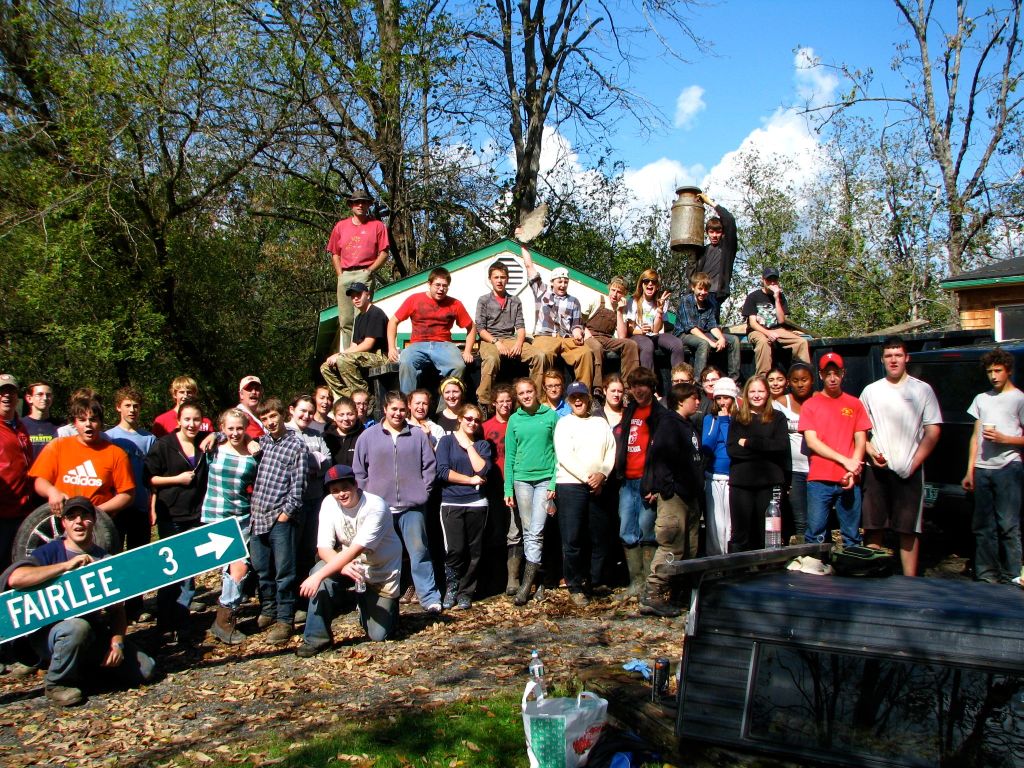
It was hard. I won’t lie. But every time I needed reminding that I was not alone, an incredible super hero gave me a hug or sent us a caring card or showed up with a way forward.
There’s one conversation that I think about often. It was four months after Irene, the beginning of winter, and I was at a low point then. A close family friend, who’s been through a lot in her life, called to check in on us. After listening to me for a while, she said this: “You’re going to make it. I know you, and I know you won’t give up until you do. But right now, this sucks. And sometimes you need someone to acknowledge that so you can move on.”
As I look back at the pieces we put together in the post-Irene jigsaw puzzle of life, I know our friend was absolutely right. It was really bad then. It is so much better now.
It’s important to know that. It’s bedrock. And I resent like hell the fact that my government is trying to take that sense of safety and normalcy away.
So my husband and I go to the protests against the minority that wants to shred our American dreams along with hundreds and thousands of others who are doing so many incredible things—together. We will pitch in for as long as it takes.
And change will come because it is the only thing that’s certain.
At the same time, I’m casting my eye (and my heart) on what needs tending close by–the card I can send, the land that needs my attention, the river that needs watching, the writing I can cast into the wind to lift the spirits of someone who feels frightened or lost.
That’s my bedrock.
So let’s acknowledge that this sucks right now. But I know we will never give up. Because that’s what we do. And together we’ll discover we’re stronger than we ever imagined.
That’s our bedrock.
So let’s get to it, shall we?
Discover more from Sonja Hakala
Subscribe to get the latest posts sent to your email.
 Sonja Hakala