
A Carding Chronicle by Sonja Hakala
The half-empty bus cautiously trundled toward the exit from the Coop’s parking lot. Every tour driver who roamed Vermont knew about Carding’s tight turns, its determined lack of large parking lots, and the town’s collective decision to keep it that way.
So there really was no choice but to move and turn the bus slowly.
Its large tires made sharp, cracking sounds as the driver guided it onto Meetinghouse Road. Inside the store, owner Andy Cooper stood among the shopping baskets and carts in its large front windows, watching until the last wisps of diesel dispersed in the morning air.
He sighed with satisfaction as he saw it leave. He looked forward to the end of October every year, and the season of gray and gloom that it ushered in. This quiet time was Andy’s respite between the hordes of leaf peepers that appeared in late September and the hordes of skiers that would descend on Mount Merino—and Cooper’s General Store—when it snowed in December.
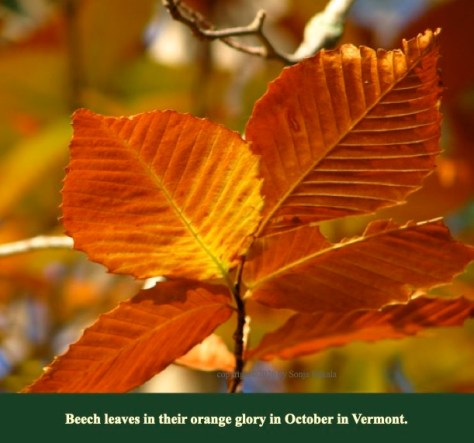
He studied the hills rising from the center of town to the west. Except for a few straggling yellow leaves that would disappear with the next good wind, the maple trees were pretty much naked. This was the time for oaks and beech to show off. They were bunched together here and there on the hillsides, their leaves making clouds of deep red tinged with smudges of orange. In a few days, the beech leaves that remained would fade to the leathery brown color of winter.
Andy felt something press his shoe, and he looked down at the dog pawing his sneaker. He stroked her soft ears, the part of her responsible for her name, Sable. He’d been dog-less for many years—and determined to stay that way—when this girl sidled out of a humane society van parked at the Coop for Pet Adoption Day. Something about the way she looked at him—and her sadness at not-belonging—re-awakened Andy’s desire to share his life with a dog.
“How about a walk, girl?” he asked. She was at the store’s door before the last word passed Andy’s lips, silently encouraging him to move faster. He sighed. Had she been a mistake? Was he too old for this?
Outside, he clipped on her leash while they threaded their way through the parking lot. He had to admit she was pretty good about not pulling but he could see it was a strain for her to resist the impulse to run. When they reached the top of the path that cut through the woods to Half Moon Lake, Sable quivered as he let her off the restraint, racing off to explore the leaves for signs of chipmunk and squirrel.
The path was ankle-deep in crisp brown leaves, and Andy deliberately scuffed through them, enjoying the rustle that accompanied his steps, and breathing in the spicy aroma that marked this time of year.
He stopped to zip his jacket close around his neck then picked up his pace. The sun’s rays slanted through the bare trees at a low angle creating ladders of light and dark across Andy’s path. “Nothin’ like the light of autumn,” Andy told himself. “How long has it been since I’ve walked down here?” He stopped to admire the stained-glass effect of the sun glowing through oak leaves.
Sable circled him, snuffling, running, and nosing among the rocks of an old stone wall. When Andy turned to watch the dog’s investigations, he saw the slightly raised furrow of leaves that marked his own passage through time and the woods, and he smiled.
At that moment, Sable looked up, and Andy realized that she had been transformed. She was no longer afraid, no longer lost. She belonged to him and he to her. They had become eager partners in life. How lucky that they had found one another.
“Let’s move on, girl,” he called. “There’s more chipmunks up ahead.”

