
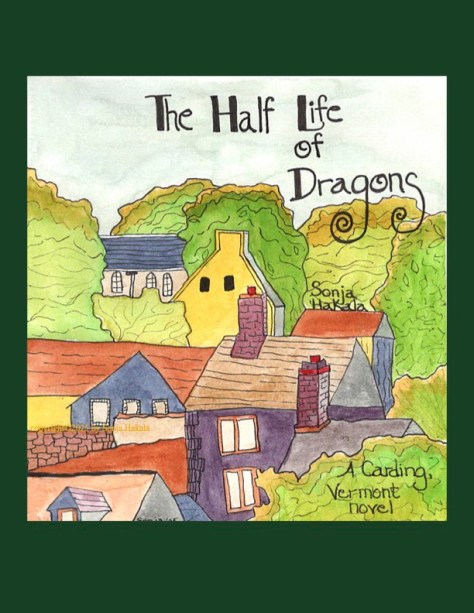
Chapter 6 of The Half Life of Dragons
by Sonja Hakala
PREVIOUSLY IN THE HALF LIFE OF DRAGONS: It’s been seven years since Timmen Eldritch, lead singer of the mystical rock band Calliope, disappeared. To this day, most people believe he died. But there are enough conspiracy theories swirling online to keep his ardent cult members hopeful of “Timmen’s return .”
Eldritch and Calliope recorded their last album in an old farmhouse in Carding, Vermont so the town has become a reluctant mecca for Calliope culties, as they call themselves. They’ve already started to gather, and no one in Carding is happy about it.
You can catch up on previous chapters of this novel in progress here.
“The truth is,” David whispered, “I don’t know where to start.” A creeping sense of dread lay like a cloud among the books and papers in his study. Every horizontal surface—including his chair—was covered with drifts of paper. He’d probably collected every newspaper and magazine article on Calliope the group as well as on every individual member of the band. Somewhere in the chaos, there were stacks of paper dedicated to each of them—Timmen, Smugs, Oliver, and Nicholas. But the piles had dissolved into the chaos weeks ago.
The situation wasn’t much better on his computer. He’d filled his laptop with links to websites full of Calliope fakery—puff stuff posted by fans alongside pseudo-serious interviews that had never actually taken place, all laced with bits of the band’s music recorded at their performances.
None of it was doing David Tarkiainen—retired history teacher and self-appointed Calliope biographer—any good at all.
He mumbled as he circled the room, unwilling to dive into the quicksand of his archives because he knew it would consume him. But he had to do something, and soon. There were indications that his wife Della was growing weary of his obsession.
“Are we having fun yet?” David jumped at the sound of her voice. “Sorry, I didn’t meant to startle you. What’s going on? I’ve never seen you so at odds with your research. What gives?”
“Look at this.” David gestured in a circle.
“I have been looking at it, and I don’t think we have a wastebasket big enough to hold it all.” She grinned at David’s look of horror. “You do remember that we will need this room when the kids come for spring break next month.”
David groaned, and sagged against a wall. “When is that?”
“The second week of April like it always is,” Della said. “Which gives you only three and a half weeks to get this cleaned up so you can’t procrastinate.”
“Which is what I am doing.”
“Yep. Tell me, is there any organization to this at all?”
“There was when I started it a couple of months ago,” David said.
“A couple of months? Try four going on five.”
“No, it can’t be that long.” David looked shocked.
“Count it up for yourself. You announced to our family that you were going to write the ‘definitive’ book on Calliope at the table on Thanksgiving.” Della just barely resisted tapping her foot in impatience. To distract herself, she picked up the pile of books closest to her feet, moved it into a corner of the room, and then picked up a second pile of books to add them to the first.
When she started stacking piles of paper on top of one another, David finally said: “No, no, please don’t do that.”
“David. you have no idea where anything is any more.” She pointed to the pile in his chair. “If you can tell me what subject that stuff represents, I’ll stop.”
“Oh, that’s easy. Those are my notes from my time at the library last night.”
“And what are the notes about?” Della asked. “And what’s that blue notebook? It looks like a booklet for an essay test.”
David shook his head. “I have no idea what it is. I had to leave the library in a hurry last night because Annie needed to get to a birthday party and she wouldn’t give me any more time and it was on the floor so I just picked it up and jammed it into my bag,” David said. He knew he was losing his battle with Della. “I meant to bring it back today.”
“In other words, you have no idea what pile it goes in.”
“True.”
Della heaved a rather large and noisy sigh mixed with all sorts of irritated sounds, the universal warning to a husband in peril. “Just stand there for a minute. I’ll be right back.”
Doors opened and closed. There were sounds of exertion, and then Della thumped something down the hallway toward her husband’s studio. “There,” she said as she deposited a large wicker laundry basket in the middle of the room. “Every scrap of paper goes in here. Pile books in that corner,” she pointed, “until they are all together, and then you can re-shelve them. No stopping to read anything. No sorting. Just one big pile.”
David’s eyebrows rose. “You’re not planning a bonfire, are you?”
“Hmph, as much as I’d like to, no. I’m going to get you organizing this stuff because you’ve been stuck for far too long. And a stuck historian is an annoying historian.” Della gave her husband her best I’m-not-kidding look. “Right then, I’ll tackle the paperwork while you tackle the books. We should have this done in a couple of hours.”
At first, David did nothing but poke at his book piles while he watched his wife straighten and stack everything she could into the laundry basket. It was full in no time. “We’ve got a couple of boxes in the basement. Don’t touch anything in the basket while I’m gone. And get going on those books. They won’t move themselves.”
“Okay, okay.”
By the time they were done clearing and cleaning, the sun was giving way to the moon. “Now that looks better,” Della said as she gave a last swipe to her husband’s desk.
“True but I still don’t know where anything is,” David said.
“Have you got any organizational plan at all?” Della asked. “Is your book about Calliope’s music or their time here in Carding or how Timmen Eldritch ripped off the French surrealist poets?”
“Funny you should bring that up because one of the things I did uncover is that Eldritch’s music changed a lot just before the band moved to Carding. It seems the French surrealist poets had had their day,” David said. “His writing became less morbid, and his lyrics made a bit more sense. The songs became more about life and less about death. It’s also when he started to paint.”
“Any idea what changed?”
“No, none.”
“Well, that sounds like your storyline then, doesn’t it?”
Her husband shook his head as he stared at the paperwork in the basket and boxes. “Maybe it would help if I created an index.”
Della smiled. “I think I just heard your inner historian wake up.”
David laughed. “What would I do without you, Della?”
“Drown in paper, I suppose.” She kissed him. “Maybe start shelving the books to give yourself more room. I’m going to figure out what we’re having for supper. Try not to get lost in here, okay?”
Books, yeah books. They’re the easiest to get organized, David thought. He hefted a large and dusty volume to read its title. “A History of Surrealism from André Breton to René Magritte. Now there’s a best seller if I ever saw one.”
The longer he worked, the calmer David felt. “I can’t believe how far afield I’d strayed,” he told Della as they sipped wine in their kitchen. “I’ve been following too many useless paths through the wilderness. Thank you for your help.”
“When my studio gets chaotic, I can’t work because it feels as though I have static in my head,” she said. “Somehow, putting things away clears the palate, you know what I mean? And as an extra-added bonus, I usually find something I’d been looking for.”
The next morning, David was up before the sun, sliding quietly along the hallway to his office with a cup of tea in hand. He took a moment to appreciate the clean floor, and the fact that he could find his chair. Then he dragged the laundry basket close to his desk. But before diving in, he made a list of questions to guide his research.
Question One: Where did the individuals who made up Calliope come from? What were their individual talents?
Question Two: How—exactly—did the band form? During their early years, several musicians came and went before Calliope settled into the quartet that became famous around the world. But who were those rejected musicians and why did they leave? (“And will any of them talk to me?” David mumbled.)
Question Three: What about Calliope’s agents? The first one was Malcolm Simpson. Little was known about him except that he’d met Timmen Eldritch in college, and that he died just before Calliope hit it big. Was there anyone around who remembered Simpson?
Question Four: The second agent, Lindsay Henderson, was still alive as far as David knew. He’d originally moved to Carding with the band but he had a couple of other acts that he managed so he wasn’t always in town. (“I need to find him,” David said as he made a note.)
Question Five: Why would a famous rock band move to a small town in Vermont? That was the question that had started David’s obsession with Calliope in the first place. Was the move universally accepted by the members of the band or did Timmen force the issue?
Question Six: At the end, the members supposedly fell out over a contract dispute, a common enough occurrence in the music industry. So what was…?
David suddenly stopped writing, his pen adrift in the air. For the life of him he could not remember seeing even one small detail about the Calliope contract. Who had drawn it up? Did they have a lawyer do it or was it something the band had written on scraps of paper? Was it just a handshake agreement? Timmen Eldritch had left some notes behind indicating that he’d been toying with the idea of suicide before he disappeared, and tucked among those notes was more than one reference to contract troubles. But what were the specifics?
“David, do you want breakfast? I’m scrambling eggs,” Della called
“Yes, be right there.” He waved his list of questions around as he entered the kitchen. “Do we have any English muffins?”
Della pointed at their toaster. “You can butter them when they pop up.” She dished while he set out plates and forks. “You were up early.”
He leaned over to kiss her. “Thank you again for the de-cluttering. It was just what I needed.” He smoothed his page of questions out on the table. “And I’ve already discovered something.
Della raised her eyebrows. “And that is?”
“The band’s contract. Supposedly the band members were in dispute about it but I haven’t found any copies of a contract or even one reference to a contract with any specifics. There are no legal records either.” David said.
“So when you talked to Agnes Findley about this, she wasn’t any help? I find that strange,” Della said.
“Aggie? What’s she got to do with Calliope?”
“David Tarkiainen, honestly. I don’t know where you keep your head sometimes. You’ve known Aggie Findlay for how many years now, and you don’t know she worked for Smith, Brownlow & Smith when they represented Timmen Eldritch? You must be the only person in Carding who doesn’t,” Della said. “Calliope is the reason why Aggie moved to Carding. It’s how she met Charlie Cooper. He was the lawyer who brought suit against Eldritch on behalf of the girl who claimed he was the father of her child.”
“You’re kidding? Why didn’t I know that?”
Della shrugged as she cleared the table. “I have no idea. Aggie’s never made any secret of it but it’s now so far in the past, the subject never comes up. And I’ve long had the impression that the good people of Carding would really rather forget Timmen Eldritch and his band so Aggie never talks about it.”
Thanks for sharing some of the minutes of your life with me and Carding, Vermont. I hope you’re enjoying The Half Life of Dragons and can visit next week for the latest chapter.
When I reach the end of the tale, the entire book will be available here as an ebook. In the meantime, if you need to catch up or would like to share this adventure with someone else, you can do so by clicking this link.
~ Sonja Hakala
Discover more from Sonja Hakala
Subscribe to get the latest posts sent to your email.
 Sonja Hakala