
by Sonja Hakala
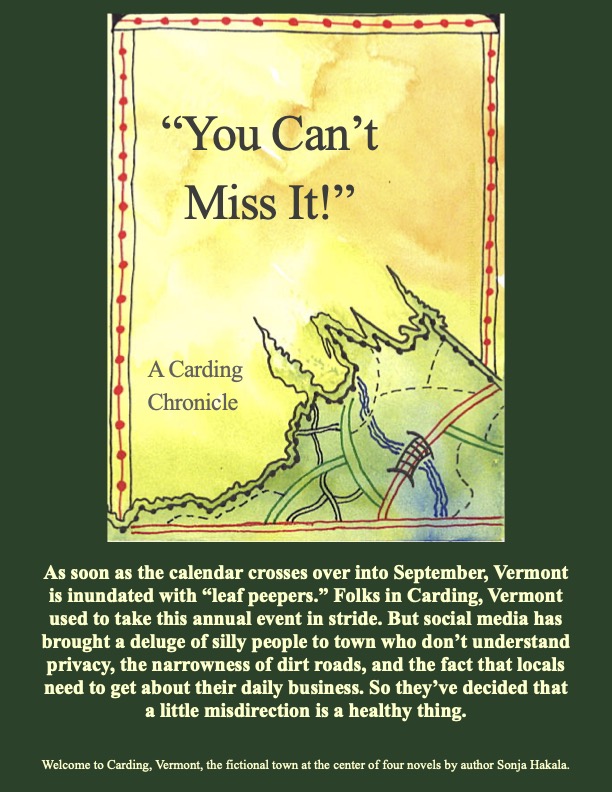
With the unfortunate rise in silliness that comes with social media, the following conversation is often heard in Cooper’s General Store (known as the Coop) as the autumnal equinox draws near. The Coop is located in the heart of Carding, Vermont.
“Excuse me,” a harried man said as he approached Brenda, the Coop’s head cashier. “Can you tell me where the Tennyson Farm is? Our GPS has sent us all over the place.”
“Aah,” said Brenda, as she pointed at the digital device in the man’s hand. “There’s your trouble. Those things just don’t work in Carding.”
The man looked very confused. “Don’t work? But this is the latest GPS on the market. It works everywhere.”
Store owner Andy Cooper shook his head as he looked over the man’s shoulder. “Well, you have to admit that Brenda is right. If that thing could get you to Tennyson’s Farm, you’d be there by now, wouldn’t you? What you need is a real map.”
“This is a real map,” the man said.
A much younger woman appeared behind the lost man. “Honey, don’t they know where that farm is? It’s getting dark and I have to take pictures for my blog.”
Andy and Brenda took a moment to mentally record the woman’s platform hiking boots, white knee socks, and short tartan skirt. They’d add these details to the story they would tell their friends later.
“Oh, we all know where the Tennyson farm is,” Andy said. “They are one of the oldest families here in Carding. We buy our Christmas trees from them every year. The problem is, you need a real map to get there.”
“You lookin’ for the Tennysons?” Lydie Talbot asked as she joined the queue. Then she spotted the woman’s skirt and the GPS in the man’s hands. “Aww, no one ever finds the Tennysons’ place with those things. You need a real map.”
The younger woman’s eyes traveled from Brenda to Andy to Lydie and back. “Come on, Hef, let’s go. I’m sure we can find it on our own.”
“Not without a map,” Gideon Brown said as he joined the circle, a six-pack of Carding Cream Ale under one arm.
The harried man shook his head. “This is a real map. Could you just tell me what street Tennysons’ place is on? That’s all I need to know.”
The Carding crowd looked at one another. “Well, it’s somewhere off of Belmont Hill,” Andy said. “Does anyone know if the road to the farm has a name?” A shrug rippled through the crowd, and Andy looked back at the lost and now thoroughly annoyed tourists. “We all just call it the Tennyson road but these things,” he pointed at the GPS, “seem to make up all sorts of names for places that we’ve never heard of. It is confusing.”
“So you don’t know where it is then,” the woman said, her firmly coifed hair now bristling with irritation.
“Oh, we all know where it is,” Brenda said. “I was up there with my granddaughter picking blueberries just two days ago.”
“Here, let me draw you a map,” Gideon offered. “It’s not hard to find once you know where to go.” Brenda tore off a length of receipt tape from her register and laid it down on the counter with a pencil.
The man-tourist sighed, disgust thick in the sound of it, as he shoved his GPS into his pocket. “What is with you people? What century do you live in?”
Andy laughed. “You do realize you’re standing in a town that’s not been on a map of Vermont since 1731. In a way, you’re trying to find something that doesn’t exist.”
“That’s impossible,” the woman snapped. “Every town has been mapped.”
“Not Carding,” Gideon said, and the crowd could hear the pride in his voice. “You see, the first map of northern New England was drawn by Robin Dutille in 1731 and printed in Boston.”
“He was one ornery man,” Andy said.
“Always thought people were going to steal his stuff,” Lydie said. “And he turned out to be right.”
“To prevent theft, Dutille put fake towns on every map he drew so that if someone plagiarized his work, he’d catch them,” Brenda said.
“In 1747, a man named Augustus Chapman decided he was going to make his own map of Vermont by basically copying Dutille’s. In the process, he left off the towns he thought were fake so that Dutille wouldn’t catch him,” Andy said. “Dutille had a habit of suing.”
“And shooting,” Lydie added.
“Chapman thought Carding was one of Dutille’s fake towns, so he left it off,” Gideon said.
“And we’ve never made it back on,” Brenda said. “And we kinda like it that way.”
The man sighed again. and Andy was sure his customers in the back of the store could feel the force of it. This was one frustrated tourist.
“Okay,” he said, pulling his GPS back out of his pocket, “let me start again. Could you tell me how to find the Tennyson Farm?”
Gideon picked up the pencil. “If you put that thing away, I’ll draw you a real map,” he said, wetting the pencil tip with his tongue.
“Okay.”
Gideon took his time. “I want to make sure you don’t get lost,” he said. “You’ve had enough of that, by the sounds of it.” His pencil zigged and zagged across the scrap of paper as Gideon told his listeners to “watch for the red house that used to be the Freeman place” and “look for the big boulder in the corner of the white fence that’s fallin’ down by the Davis place.” Then he finished up by marking a large X in the upper right of the paper, handing it to the tourists with a big smile.
“That’s the Tennyson place right there. You can’t miss it,” he said.
Everyone stayed quiet until the tourists sped out of the parking lot. “So Gideon, where did you send them?” Brenda asked as she rang up his cream ale.
“”Hmm, not sure. Somewhere in New Hampshire by the sounds of it.” He shook his head as everyone laughed. “I think we’ve all had enough of those blogging people to last a lifetime, don’t you?”
The Carding Chronicles are short stories written by author Sonja Hakala about the Vermont town that no one can quite find on a map. They feature the characters in her four Carding novels.
The Carding books are available from Amazon and the Chronicles appear here, on this website, every Monday. Hope to see you next week.
Discover more from Sonja Hakala
Subscribe to get the latest posts sent to your email.
 Sonja Hakala