
by Sonja Hakala
“You’re doing what?” Ruth Goodwin gaped at her friend Edie. “You can’t be serious.”
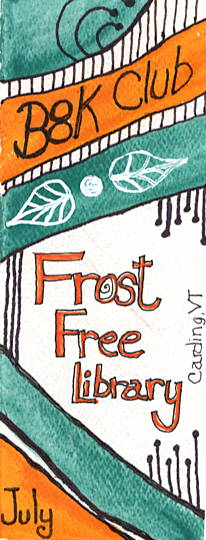
Edie dabbed a bite of pancake into her puddle of maple syrup. Wednesday morning breakfast was a regular part of the social calendar forged among Ruth, Edie, and Aggie Findlay. Had been for years. “I’m taking a break from the Frost Free Library and the book club,” she said. “Don’t look so pained, Ruthie. It’s only for the rest of the summer.”
“But why?” Aggie asked. “You love the library. And I thought you loved the book club, too.”
“I do.” Edie inhaled some more of her coffee. “That’s why I’m taking a hiatus.”
“But why?” Ruth asked.
Edie grinned at her two friends. “Tell me, how many unread books do you have on your shelves or on your bedside table?”
Ruth and Aggie eyeballed one another. “Well, a few,” Ruth finally said.
Aggie started to laugh. “And Edie has more than either one of us. Remember that binge she went on during the pandemic?”
“Oh yeah, we thought she had started dating the guy from UPS, remember?” Ruth said. “But just because you have unread books at home doesn’t mean you have to quit the library. Just switch back and forth between your own books and those at Frost Free.”
“I’ve tried,” Edie said. “I’ve been trying for a couple of months now. But every time I go into the library to get just one book, I come out with three or four. And then I read those instead of the ones on my own shelves. So I figured if I didn’t go into the library for a while—just for a while—then I would whittle down the reading pile next to my bed. That’s all.”
“Have you explained this to Annie? She’ll think she’s done something to offend you if you start avoiding the library,” Aggie said. As the current chair of the library trustees, she had a vested interest in keeping Annie Crane happy. Good librarians were hard to find.
“I don’t know what to say. ‘Hi Annie, I can’t come in because I’m a book addict,’” Edie said, spreading her hands out on the table in front of her. “Look, I’m open to suggestions. I mean, I spent money on the books on my shelves but then I go to the library, and see the new mysteries or fiction that Annie puts on the shelf, and somehow those books come home with me, and that’s what I end up reading.”
Ruth and Aggie looked at one another. “No will power,” Ruth said.
“No will power at all,” Aggie agreed. She leaned across the table. “So if you like mysteries and fiction so much, what did you buy during the pandemic?”
“Hmm, mostly non-fiction—nature, some history, female spies in World War II, a couple of books of fairy tales, a couple of classic novels, that sort of thing.”
Aggie busied herself flattening the last crumbs of her muffin against her plate with her fork. “Let me guess, you prefer to have the quicker reading stuff in your hands just before you fall asleep, is that right?”
Edie nodded. “I usually don’t last more than twenty minutes so I gravitate toward puzzly mysteries and books that don’t have the words ‘gritty’ or ‘disturbing’ in their blurbs.”
“Gritty, hmph. Isn’t that what the news is for—gritty? And I daresay there’s no one at this table who watches the news right before they go to bed,” Aggie said.
“You know I don’t. I can barely read the news never mind watch it, and very little of that,” Ruth laughed. “Going back to book blurbs, I find that ‘compelling,’ ‘gripping,’ and ‘heart-thumping’ are not my thing either. I find that whatever I read or watch just before retiring gets dragged into my dreams, and who needs gritty dreams? ”
“Do you suppose that whoever’s in charge of blurbs in the publishing companies gets a cheat sheet of adjectives to make books sound so much alike? Good book, bad book, they all sound the same in a blurb,” Aggie said. “For example, to me the word ‘complex’ has come to mean that an author has plugged so many bland characters into her book, I will never remember who is who even if they give me a cast list.”
“Then there’s ‘hard-hitting’ and ‘hard-boiled’ which are just another way of saying ‘too-reliant on guns,’ and ‘violence against women,” Edie said. “And to me, the term ‘noir’ usually means particularly dreadful writing. I mean, have you ever tried to read The Maltese Falcon? Or watch the movie? It makes no sense at all, and yet Dashiell Hammett gets all this play about being such a great writer.”
“Well, he was good-looking and he did write The Thin Man,” Ruth said.
The three of them laughed.
“Okay, let’s try to solve Edie’s problem,” Aggie said. “How do we corner her into reading more books from her own bookshelf so she can stop feeling guilty about giving storage space to those that are unread?”
“Hmmm, I wonder if part of the problem is familiarity,” Ruth said.
“What?”
“You mean as in ‘breeding contempt?’” Edie said.
“Not quite but along the same idea,” Ruth said. “What does the library do to make its books attractive?”
“Well, there are always those themed displays of books just inside the door when you walk in,” Aggie said. “I always stop and look at those and often take one home. I’ve even made a few thematic suggestions.”
“Oh yeah, I remember the one you made that was books about books and libraries. I had no idea how many there were,” Edie said.
“Uh huh. And how are those books displayed?” Ruth asked.
“Face out,” Aggie and Edie said together.
“So think about it, those books could be among the oldest volumes in the library but because they’ve been picked and turned face out on that wall, they somehow come alive, right?” Ruth said. “In a way, they’ve become new and unfamiliar so you get attracted to them. Well, I’ve been in your house a gazillion times, Edie, and like all of us, the books on your bookshelves are sitting spine out. Maybe you should make your own display area.”
“Or maybe we could swap our unread books with one another,” Aggie said. “By the time they circulate back to us, they’d be unfamiliar again.”
“Oh, I like all these ideas,” Edie said.
The trio hoisted their coffee cups with a whoop that made Edie’s grandkids, who were sitting in a booth at the other end of the Crow Town Bakery, lift their heads from their phones. “What do you suppose that was all about?” Faye asked her brother Wil.
“I dunno. Last I knew, they were talking about books,” he said. “I can’t see getting excited about stuff made of paper and ink, you know? So did you find anything new on FaceBook?”
“Nah, same old same old,” Faye said. “What about you and Tik Tok?”
Wil leaned back in his seat as he stuffed his phone into a pocket. “Oh I gave up on that a while ago. It’s become so repetitive, it makes my brain go numb, you know?”
“Hmm. yeah.” Faye stared at her grandmother for a while. Edie’s softened face was all twinkly, and her laugh, mingling with those of her friends, had become music. Then she looked down at the phone in her hands. She’d just had breakfast with her brother, the first time they’d been together for weeks. And they hadn’t said a word to one another that whole time. She looked at Edie again then put her phone away.
“Where are you going?” Wil asked as she stood up.
“Oh, to the library,” Faye said. “It’s been a while. I thought I would see what’s new. You want to come?”
The Carding Chronicles are short stories written by author Sonja Hakala about the Vermont town that no one can quite find on a map. They feature the characters in her four Carding novels.
The Carding books are available from Amazon and the Chronicles appear here, on this website, every Monday. Hope to see you next week.
Discover more from Sonja Hakala
Subscribe to get the latest posts sent to your email.
 Sonja Hakala