
by Sonja Hakala
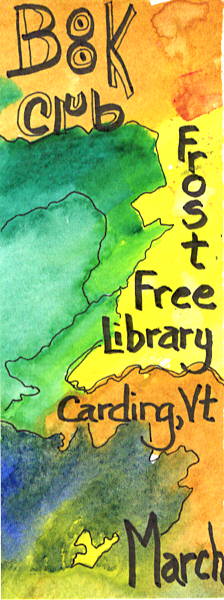
The membership of the Carding, Vermont Book Club is fluid. A dozen or so stalwarts show up all winter, slogging through cold, ice, and the dreaded blend of slush and snow known as “wintry mix” to share hot tea and hot takes on their favorite books. They wouldn’t miss it for the world.
In addition to that core, there’s a floating mass of fare-thee-well members who drop in if the roads are absolutely clear and the temperatures are above freezing. There are some who reside in Carding only for the summer-through-autumn months, and they add a bit of flutter to the group. And some folks just like to brag that they are members of a book club without actually doing any of the reading.
In other words, hobnobbers. They drive the stalwarts nuts but since it’s an-open-to-the-public club meeting in a public space, what can you do?
To be honest, the group kinda gave up on reading the same book-of-the-month idea long ago because finding a piece of fiction or non-fiction that satisfied a group of readers with tastes that range from Stephen King to Jane Austen just got to be too much of a challenge.
Besides, they were spending more time deciding on a book than they were spending discussing it. “Which is ridiculous,” Ruth Goodwin pointed out.
So the group has happily evolved into a reader’s sharing circle, and it’s worked remarkably well because the participants have slightly different but overlapping tastes in books. Well, except for Denise Digby who stubbornly resists the idea that Stephen King is not a literary god.
“No accounting for taste,” Agnes Findley mutters every time she hears that opinion.
It is true that the differences in taste among the group are interesting. Ruth loves a good mystery better than anything. But she shares a deep interest in history with several others. Edie enjoys mysteries as well but also includes a goodly amount of classic literature in her reading, especially books from the end of the nineteenth through the early-twentieth centuries. Agnes’s first love is gardening, and she will read the backs of seed packets if there’s nothing else at hand while Vivian Smart, intrepid hiker that she is, is into the worlds of theater and fashion, something that makes no sense to anyone in the book club because she doesn’t belong to any local theater groups nor does her personal wardrobe vary much beyond hiking boots and cargo pants.
Go figure.
But there are a few authors they all agree on and strangely enough one of them is a British mystery writer by the name of Christopher Fowler, the creator of a series about the Peculiar Crimes Unit of London, England. Chris, as the members call him, celebrates his birthday in March. Sadly, it is also the month that he died of cancer.
The Peculiar Crimes series is something of an acquired taste, by turns uncanny, fascinating, willfully eccentric, funnier than hell, and often dancing on the knife edge of bizarre. The unit is led by a wildly aberrant detective named Arthur Bryant who, along with his straight-man partner John May, has been solving crimes in London since the end of World War II.
Everyone in the book club agrees that Arthur is the man. They speed through the pages of Fowler’s novels with names such as The Water Room, Burning Man, and Oranges and Lemons just to see what Arthur will say next. He’s blunt, bitingly truthful, and philosophical all at the same time. After Fowler died, the club’s members agreed that they would toast the author in March by reading their favorite PCU quotes.
“This one is from White Corridor,” Edie said. “It’s a quote for our times. ‘If you take away knowledge you create myth, not the old myths that help to underpin and elucidate the human condition, but ones with the more sinister purpose of increasing commercial gain.’”
“I have a partner for that one,” Ruth Goodwin said, “From Oranges and Lemons: ‘When democracy is working correctly nobody is satisfied.’”
“Oh, I think that book may be my favorite,” Vivian said. “Though if pressed, I can’t really choose. I like this observation from The Lonely Hour.”
“Ooh sorry to interrupt but that book has one of my favorite church names in it,” Denise said. “The Church of the Faithless Multitude. Sorry but I didn’t want to forget to share that one.”
“Quite all right,” Vivian said. “Here’s the quote: ’The way we gather information has changed. The Internet lies; it assumes intimacies that don’t exist. When you become active on a social network you find friends you’ve never heard of, enemies you’ve never met. It’s a gift to the unscrupulous and means that your killer can get his information in a thousand different ways. He does’t follow the rules of the majority. He won’t answer to you.’”
They all sighed. Everyone in the book club felt she struggled with some sort of web addiction that made her unhappy.
“There are so many great, short descriptions in these books,” Edie said. “Like this one from Strange Tide: ‘Ali was not a bad man, but he could not afford to be an entirely good one either.’ Or this description of Arthur in Off the Rails: ‘White seedlings of hair poked up around his ears like pond grass.’ Or this one from Wild Chamber: ‘At the end of every party there was always a girl left crying, never a man.’”
“Gawd, that sounds like every middle school dance I ever chaperoned,” Denise said. When asked, she always described herself as a recovering teacher. “The boys mass on one side of the gym while the girls walk around in groups, and inevitably, a girl in one of those groups will start to cry over something and then the whole lot of them traipse back and forth to the ladies room. I do not miss that drama at all.”
“Hear, hear,” Agnes said. She paged through the volume in her hand. “This is a bit longer than the others but for me, it embodies Arthur Bryant. This is a conversation he’s having with his landlady or quasi-wife. I’ve never been quite clear on their exact relationship status.” She sipped her tea. “It starts with Arthur speaking: ‘Oh please spare me the sanctimony. The Christian legend is an embarrassingly childish reiteration of hoary old vegetation myths, the simple impregnation-and-resurrection cycle of pagan tree gods. You should try one of the more complex, grown-up religions from the Far East for a while rather than worrying over a bunch of ghost stories concocted by bored shepherds in tents. Wait until they confirm life on other planets, that’ll mess up Christianity for you.’
“‘Shame on you, you wicked old man! Every time you blaspheme, an angel is stripped of its wings.’
“‘A good job, too.Sanctimonious bloody things drifting about with their harps, ticking people off all the time like feathered traffic wardens.’”
The book club members laughed.
“Oh, I can’t believe Christopher Fowler is gone,” Ruth said. She raised her teacup. “But I can believe I’m going to treat myself to a re-read of these books because there’s nothing else quite like them. To one of our favorite authors. As Arthur Bryant said: ‘We should enjoy being our age and appreciate the benefits of experience.’”
The Carding Chronicles are short stories written by author Sonja Hakala about the Vermont town that no one can quite find on a map. They feature the characters in the four Carding novels.
The Carding books are available from Amazon and the Chronicles appear here, on this website, every Monday. Hope to see you next week.
Discover more from Sonja Hakala
Subscribe to get the latest posts sent to your email.
 Sonja Hakala